Fuss Free Mobile – Stop Nuisance Calls
 SHARE


Stop Nuisance Calls On Your Mobile

Calls from unknown numbers can be frustrating, particularly when they turn out to be unwanted marketing, cold callers or potential scams. For people who simply want a mobile phone that keeps them connected to friends, family and important services, dealing with unwanted callers can make using a phone unnecessarily complicated.
This was one of the problems WightFibre’s Fuss Free Phone service was designed to address. By combining an easy-to-use mobile with a Trusted Callers List and access to UK-based telephonists, the service aimed to make staying connected simpler.
Rather than having to deal with every unknown caller, customers could identify the people they wanted to hear from and have greater control over who could reach their Fuss Free Phone mobile.
How Fuss Free Phone Helped Stop Nuisance Calls
When signing up for the service, customers were provided with a Trusted Callers List. This allowed them to provide WightFibre with the telephone numbers of the friends, relatives and other contacts they wanted to speak to.
For the No Nuisance Calls service, the list was used to help ensure that recognised contacts could be connected straight through to the customer’s Fuss Free Phone mobile.
This provided a straightforward way of managing calls without requiring customers to navigate complicated settings or regularly block individual numbers.
It was particularly useful for anyone looking for a simple mobile experience focused on communicating with the people who mattered most.
Why Unwanted Calls Can Be a Problem
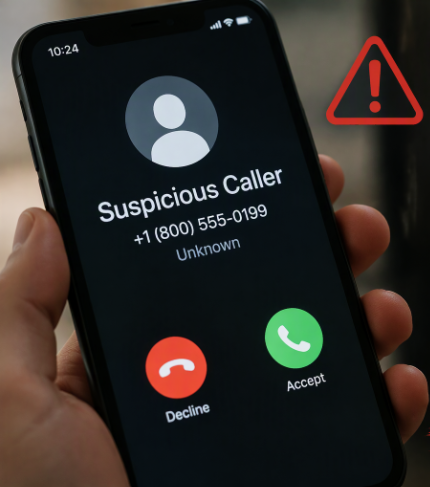
Unwanted calls come in many different forms. They can include unsolicited marketing, automated messages, silent callers and attempts to obtain personal or financial information.
Importantly, not every unwanted caller is necessarily a scammer. Ofcom distinguishes nuisance marketing from fraudulent communications, although both can create problems for mobile users.
Current UK guidance can also help people who encounter suspicious activity. Ofcom advises people who suspect a scam to hang up, avoid sharing personal or financial details and use an independently verified number if they need to contact the organisation the caller claims to represent. Suspicious mobile numbers can also be reported free to 7726.
Making Calls with Your Own Personal Operator
The Fuss Free Phone service and easy-to-use mobile were designed with simplicity in mind. The aim was to give customers the technology they needed without making them learn how to use lots of complicated functions.
When customers signed up, they could provide the names and numbers of the people and places they regularly wanted to contact.
To make a call, customers could simply press the large button on the back of the phone to connect to one of the service’s UK-based telephonists. The telephonist could then put the customer through to the requested contact.
This meant customers didn’t necessarily need to navigate menus or remember how to access every feature of the mobile independently.
The team of telephonists could even help with text messages by reading messages to customers or sending messages on their behalf.
A Simple Phone for Everyday Calls
The Doro 614 was selected as the all-round mobile for the Fuss Free Phones service.
Its design included a clear screen, strong contrast and large buttons intended to make everyday operation straightforward.
The clamshell design also meant answering and ending calls could be as simple as opening or closing the handset. This offered an alternative to navigating touchscreen controls or searching for small on-screen buttons.
Another useful feature was the charging cradle supplied with the handset. Instead of regularly locating a small charging port and connecting a cable, the handset could be placed into its cradle when it needed charging.
Together, these features supported the main aim of Fuss Free Phone: simplifying mobile communication.
More Than Just Making Calls
The service wasn’t only designed around speaking to friends and relatives.
Fuss Free Phone telephonists could assist customers with other everyday requests, such as booking a taxi or ordering flowers.
The service also included support for emergencies. In an emergency situation, a telephonist could contact designated friends or relatives, or the emergency services, and remain on the phone until help arrived.
This human element was an important part of the original service. While the handset itself was deliberately kept simple, having access to an operator meant customers could request additional assistance without having to navigate different apps and features.
Staying Safe from Suspicious Calls Today
Although this article describes WightFibre’s historic Fuss Free Phone service, dealing with suspicious calls remains an important issue today.
The National Cyber Security Centre warns that scammers may impersonate trusted organisations such as banks or the police and attempt to obtain personal information or convince people to transfer money.
If something doesn’t seem right, the safest approach is to stop the conversation rather than feeling pressured to continue. The National Cyber Security Centre advises checking an organisation using contact details obtained independently instead of relying on details supplied by a suspicious caller.
For unwanted marketing specifically, Ofcom advises that people can register free with the Telephone Preference Service (TPS) to reduce unsolicited marketing calls. It also advises reporting continued nuisance marketing to the Information Commissioner’s Office (ICO) where appropriate.
The ICO provides an online reporting service for nuisance sales calls and spam texts, using reports to help investigate those responsible.
Keeping Important Calls Simple
At its heart, the Fuss Free Phone concept was about simplifying communication.
A mobile phone should make it easier to reach friends, relatives and important services. For customers who didn’t want complicated technology or constant unwanted interruptions, the combination of a simple handset, Trusted Callers List and access to telephonists offered a different approach.
Managing unwanted calls was an important part of that experience. Instead of expecting every customer to understand complicated mobile settings and filtering features, the service was designed to handle much of the complexity for them.
Technology has changed considerably since Fuss Free Phone was introduced, but the principle of making communication simple and accessible remains relevant.
Modern smartphones now provide their own options for blocking numbers and screening suspicious callers, while networks and regulators continue to introduce measures designed to protect consumers. Ofcom notes that mobile devices, apps and providers can offer spam warnings and call-screening features, although these warnings are not always accurate.
For anyone receiving suspicious calls today, the key advice remains simple: don’t provide sensitive personal or financial details, hang up if uncertain and verify the organisation independently before making contact again.
Would you like more information?
Simply call us on 01983 240 240 or click here for more info.